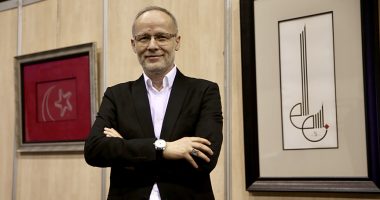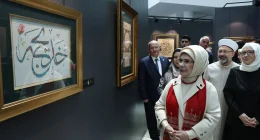
Born in 1952 in Malatya, Turkey, Hikmet Barutçugil is a celebrated Ebru artist known for “Barut Ebru.” During his first year of higher education, Barutçugil met Professor Emin Barın, who inspired him to delve into the art of calligraphy. This exploration soon led him to discover Ebru, the traditional Turkish art of marbling. His passion for Ebru quickly grew, driving him to conduct extensive research and experimentation, revolutionizing the art with his own approach which is now called “Barut Ebru.”
In our recent conversation, Hikmet Barutçugil shared insights into his lifelong dedication to the art of Ebru, his innovative techniques, and how his work has evolved over the years. He also gave in-depth explanations on Ebru and how it originated and evolved through the centuries. Join us as we delve into his artistic journey and uncover the stories behind his unique approach to this traditional art form:
Could you tell us a bit about your artistic journey and how it began?
It is a love that has fallen into my heart; to this day, I am in pursuit of it. I began my art education at the State Academy of Fine Arts in 1973.
How did you discover Ebru as an art form?
I had a great affection for writing. When I asked my teacher, “How do we learn this, how do we do it?” he sent me to the Süleymaniye Library. While examining the masterpieces of ancient writing there, I noticed that some had painted paper on their margins, while others had it on their surfaces. A captivating beauty, clearly not made with a brush. When I asked my teacher, “What are those colored papers?” he said, “They are Ebru, it’s made in water.” Through trial and error, I tried to float whatever paint passed through my hand on whatever water I had, in order to capture images.
How did this experimentation evolve over time?
In 1987, I was invited to an exhibition at the Royal College of Art in London. There, a curator lady who knows about Ebru used the term “Barut Ebru.” She wrote a short article saying, “There is a type of marbling we have never known before.” So the name just stuck like that.
That must have been a pivotal moment. How did this recognition influence your work moving forward?
Of course, it was a great motivating event for me to teach at the Royal College of London and to hold an exhibition. I had also accelerated my work. I have combined calligraphy with other arts to reach different dimensions.
How has your work impacted the art of Ebru, in which ways have you experimented with the art form?
Ebru has always come down to us as a work on paper throughout history, but when we use the right paint and the right materials, there is no surface that cannot be marbled; we even marbled wax. This, of course, led to an increased interest in art. As a result of 17 years of work, I have compiled a book on how to create traditional Ebru, which has become a very popular, beloved, and accessible art form that anyone can try today.
Would you like to tell us about how and where Ebru originated, how has this tradition made it down to contemporary artists such as yourself?
Ebru historians attribute the origins of this art to the Turkestan region. We now call it “Central Asia,” but its real name is “Turkestan.” Şeyh Sadık Efendi, who learned marbling in Bukhara and practiced this art at the Uzbek Tekke in Istanbul, was later followed by his son Ibrahim Edhem Efendi, and then by Necmettin Okyay and Mustafa Düzgünman, who was inspired by him. It comes down to us through this chain.
Can you elaborate on the name “Ebru” and the art’s travel across cultures?
The first known name is “ebre” in Chagatai. “Ebre” is a word that means “veined, like moire, colorful.” This technique came to Iran via the Silk Road, where they called it “ebri,” meaning “cloud-like, resembling a cloud.” In Iran, they also named this art “abru,” where “ab” means water and “ru” means face or surface. So, “abru” means the surface of the water. This is the shortest description of Ebru: image of the water-surface. The paints are floated on the water, shaped, and then transferred to paper. When it came to Türkiye, we called it “Ebru.”
How did the name “Ebru” spread around the globe, and how was it perceived?
In the early 17th century, in 1608, information about the art of Ebru first made it to the West. This information was conveyed by a traveler, and its name in Europe became “Turkish paper.” Later, we produced these arts, and it became known in the West as “Turkish marble paper.” Eventually, it became simply “marble paper.” However, today, these developments in Turkey have led to the term “Ebru” becoming established internationally. Today, from Canada to Japan, and from Australia to Argentina, everyone engaged in this art calls it “Ebru.”
You have mentioned a novel technique invented by yourself. What makes the Barut Ebru technique unique?
Shapes are created under the weight of a magma layer as the mass presses into each other at a temperature of 4000 degrees while in liquid form: soil layers, textures found in some marbles… The technique that emerges on water in Barut Ebru is similar. Colors can blend with each other through intermediate tones, allowing for infinite colors. One of its most important features is fluidity, the texture that exists within the fluidity of water. In the chaos of water, this texture is very important and reminds one of infinity. Each work is a fractal geometry – the whole is an artwork, the part is an artwork, and the part of the part is also an artwork.
How would you compare the characteristics of Western art with the essence of Islamic art, particularly Ebru?
Western arts appeal to the eye. There is proportion, balance, aesthetics, etc. But our arts appeal to the heart. Unfortunately, there is no equivalent for the word “gönül” in any Western languages. The “gönül” is not just the heart; it is where Allah manifests in humans. This is a feature of Islamic art that we summarize with the word “grace” (letafet), meaning “in transcendence” or “exhilaration” (vecd). Sometimes you forget everything and enter a completely different dimension, gazing in awe at the majesty of the Creator. That moment is truly beautiful and leaves a serious impact.
We have talked about Ebru’s journey around the world, but how has the art of Ebru survived and evolved in Turkiye?
Our arts have been neglected during the Westernization movements. The rules of Islamic arts are different, their foundations and values are different. We tried to evaluate those values through Western arts, which led to our arts being greatly neglected, pushed aside, and even disregarded. But the truth is that the sun cannot be covered with mud. Even if you throw gold into the mud, it doesn’t lose its value. Ebru, like a plane tree, was cut down but started to sprout again because its roots were strong. Fifty years ago, we couldn’t have imagined that Ebru would evolve into what it is today. Thank God, there have been very serious developments now.
What role has your book played in the resurgence of Ebru?
Information about the art of Ebru had not been shared much before. Our style was conversational, word of mouth, and we didn’t develop the habit of writing. But when a book explaining the techniques for making Ebru came out, everything changed. Ebru found its place within modern arts by merging with other art forms. Today, it is estimated that around 15,000 people are engaged in Ebru. Exhibitions are being held, galleries are interested, and a market has formed.
What is your vision for the future of Ebru, and do you think arts relate to building a new civilization?
If we want to be international, we must first be national. We cannot build a civilization by copying others. Ability thrives on recognition, and a product without buyers is lost. Ebru developed as a side craft used in book arts and calligraphy until Necmettin Okyay, but today it is framed and hung on walls as abstract art with a serious market. Is this enough? No. The civilization we will establish for future generations must be rooted in our essence. Now, when we go to the West with our unique arts, we are met with admiration. God willing, this will continue to develop further, and Ebru will once again reach the days it rightfully deserves.
We thank Barutçugil for his time and the valuable information he shared with us.