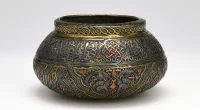

‘Hafla’ features a broad spectrum of arts and design, with a significant emphasis on Saudi Arabia
DUBAI: Throughout August, Sotheby’s is hosting “Hafla,” a sale series described as “a celebration of Middle Eastern art.”
“Hafla” consists of four distinct exhibitions: “Khamseen: 50 Years of Saudi Visual Art,” “Masarat Al-Hibr: Exceptional Qur’anic and Calligraphic Works from the Bashir Mohamed Family Collection,” “A2Z Advisory Jewelry at Sotheby’s,” and a special capsule collection of handbags with designs inspired by Saudi Arabia.
The largest component of “Hafla” is “Khamseen,” according to Alexandra Roy, Sotheby’s head of sale for modern and contemporary Middle Eastern art. Curated in partnership with Jeddah’s Hafez Gallery and its founder, Qaswra Hafez, the exhibition showcases paintings, sculptures, photography, prints, and installations ranging from the 1960s to the present.

“We’ve known Qaswra Hafez for a long time, and this has been a project that he’s been thinking about doing for a while,” Roy says. “It’s very much overdue. There have been some amazing shows in London on Saudi visual culture and, of course, a lot is happening in the Kingdom right now. It’s an amazing moment to be part of that.
“Sotheby’s was part of the two art biennales in Saudi Arabia, so we’re continuing on from that,” she adds. “We have 60 artists (represented) and it’s the first time some of the works have ever been seen. We go back to circa 1965, and it’s been difficult to source works from as early as that, but we really wanted to show (work) from the pioneers.
“I actually didn’t know a lot of these artists, so I’ve been reading about them, and it’s pretty incredible. A lot of them were sent on scholarships abroad and studied in Italy, in France, and then came back and were responsible for setting up exhibitions themselves. And even after 1979 — the period in which the Kingdom became more conservative — artists really continued producing. They were also really supporting each other.”
Roy continues, “We’ve known Qaswra Hafez for a long time, and this has been a project that he’s been thinking about doing for a while. It’s very much overdue. There have been some amazing shows in London on Saudi visual culture, and, of course, a lot is happening in the Kingdom right now. It’s an amazing moment to be part of that.”

“Sotheby’s was part of the two art biennales in Saudi Arabia, so we’re continuing on from that,” she adds. “We have 60 artists (represented), and it’s the first time some of the works have ever been seen. We go back to circa 1965, and it’s been difficult to source works from as early as that, but we really wanted to show (work) from the pioneers.”
“I actually didn’t know a lot of these artists, so I’ve been reading about them, and it’s pretty incredible. A lot of them were sent on scholarships abroad and studied in Italy, in France, and then came back and were responsible for setting up exhibitions themselves. And even after 1979 — the period in which the Kingdom became more conservative — artists really continued producing. They were also really supporting each other.”
Earlier this year, she collaborated closely with Asprey to design five iterations of their 1781 Asprey pochette bag, utilizing textiles inspired by the five main regions of Saudi Arabia,” Stevens explains. “We believed, as part of this initiative in the luxury sector, it perfectly marries Saudi heritage with one of Britain’s oldest luxury houses.”
Another facet of the luxury side of “Hafla” is a collaboration with A2Z, established in 2018 by Abdulrahman Al-Zayani, whom Stevens refers to as the Gulf’s leading jewelry and art consultant.
“We’re taking over the Sotheby’s salon space on New Bond Street, where we’ll exhibit about 140 pieces that are either influenced by Eastern design or have some form of connection,” she says. “We have some exceptional designs from the past century, including remarkable art deco pieces, stunning colored gemstones, and impressive diamonds, along with works by leading contemporary designers. It’s an eclectic mix. And, once again, we’ll host a few educational talks, including one with (Al-Zayani) focusing on the art of collecting. It will be exciting to explore that topic with him.”
The final section of “Hafla” presents 28 calligraphic and Qur’anic works from the family collection of pioneering Islamic art expert Bashir Mohamed.
“We’re starting from the earliest examples of the script from the 9th century up until contemporary iterations in the 21st century,” says Islamic and Indian art specialist Frankie Keyworth. “It’s a blend of Qur’anic leaves and secular calligraphic leaves, tracing how the script evolved and how each region developed its own identity by incorporating the script into their works.”

Keyworth highlights two particularly noteworthy pieces: A bifolio from the famed Blue Qur’an, and an illuminated firman (mandate) bearing the tughra (a calligraphic monogram that served as an official signature) of Suleyman the Magnificent, from 1565 CE.
Regarding the former, Keyworth comments: “We’ve seen individual leaves from the (Blue Qur’an) at auction or in exhibitions, but it’s incredibly exciting to have a bifolio because it allows you to appreciate its true scale and the impressive nature of the work.”
The firman, Keyworth notes, is “so intricately detailed, so beautifully illuminated. The way the calligraphic monogram integrates with the decoration creates a standalone piece of art.”
“Hafla” launched at a time when the UK was facing social unrest, largely fueled by right-wing groups inciting Islamophobia. Although the sale series was planned well in advance, the timing of a showcase of Middle Eastern culture feels especially pertinent.
“I think it’s hugely important and a very impactful way to open up greater exchanges and cultural understanding,” says Stevens. “I’m really looking forward to the educational side as well, because I think it’s going to deliver so much more understanding.”